
Friday October 16, 2026
7:00 PM
Thornton Arts & Culture Center: 9209 Dorothy Blvd, Thornton, CO 80229
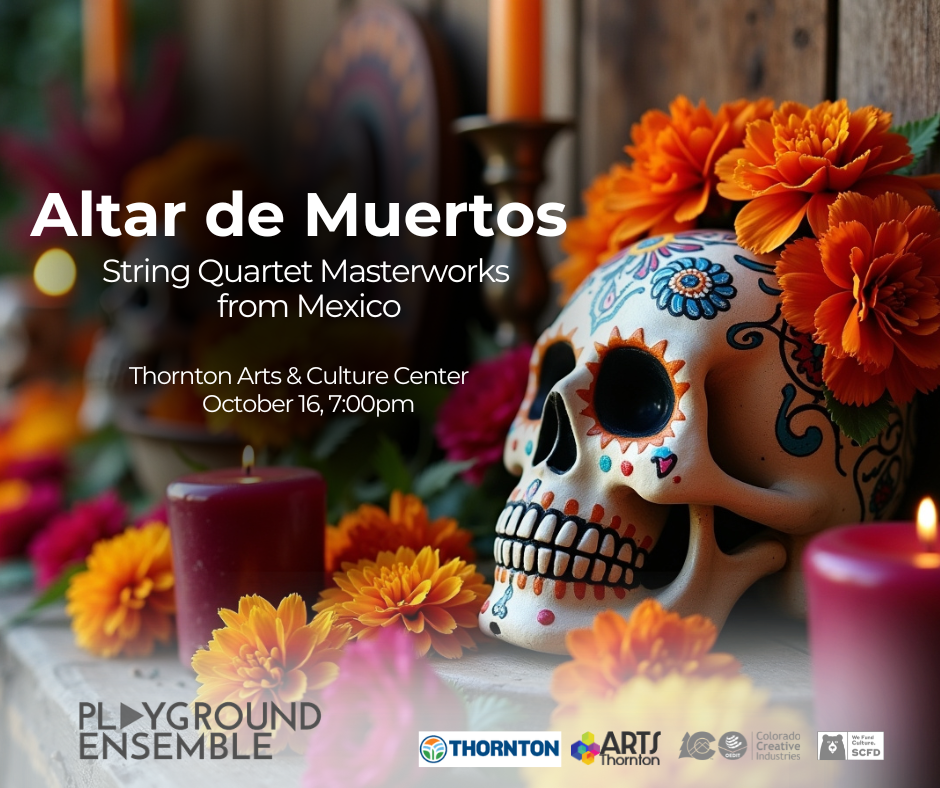
Celebrate Dia de los Muertos with the Playground Ensemble String Quartet's performance of Gabriela Ortiz’s ceremonial Altar de Muertos. This theatrical performance features water drums, traditional ankle rattles, and masks made by local Mexican artist, Josefina Calzada. Hosted inside an intimate gallery space, enjoy music and refreshments surrounded by local artist, Cal Duran’s exhibition, “Muertos: A Journey of Life and Death as One” on display in its debut week. Attendees are invited to honor loved ones by bringing an offering for the ofrenda before the show.
Doors at 6:30 PM, show at 7:00 PM.
Sarah Whitnah, Violin
Jackson Bailey, Violin
Don Schumacher, Viola
David Short, Cello
Presented in partnership with the City of Thornton’s Arts Thornton Music Series, which occurs on third Fridays through October 16 and brings the community together through shared artistic experiences.
Thornton Arts & Culture is a division of the Thornton Parks and Recreation Department and was established in 2006. The division offers year-round programs and community-based events in partnership with other city departments, nonprofit organizations, and regional funders. For more information, visit goCOT.net/musicseries, email artsthornton@ThorntonCO.gov or call 720-977-5887.
Program
Altar de Muertos by Gabriela Ortiz
“The tradition of the Day of the Dead festivities in Mexico is the source of inspiration for the creation of a work for string quartet whose ideas could reflect the internal search between the real and the magic, a duality always present in Mexican culture, from the past to this present.
Altar de Muertos is divided into four parts, each of these describe diverse moods, traditions and the spiritual worlds which shape to the global concept of death in Mexico, plus my own personal concept of death. First part: "Ofrenda." This music describes the visit of four spirits to the altar, each one singing his/her own ofrenda (offering) towards the end of this movement, the four spirits converge in a single chant to as the end of a funeral procession.
Second part: "Mictlan." Pre-Hispanic Culture conceived death as a cycle in constant movement; A cycle where life is extended towards death and vice versa when death becomes in the essence of life itself. The passage of death, and the eternal struggle between night and day recreate and obsessive ritual music always in continuous movement which starting and ending points are always bonded.
Third part: "Danza Macabra." Human life is like a shadow. The advent of European culture in Mexico and Mesoamerica brought an image of death which is static, motionless, where there is only place for a constant alternative between glory and hell. This music is nourished from fantastic images taking place one after another. Phantasmagoria and magic are always present.
Fourth part: "La Calaca." Syncretism and the concept of death in modern Mexico, chaos and the richness of multiple symbols, where the duality of life is always present: sacred and profane; good and evil; night and day; joy and sorrow. This movement reflects a musical world full of joy, vitality and a great expressive force. At the end of "La Calaca" I decided to quote a melody of Huichol origin, which attracted me when I first heard it. That melody was sung by Familia de la Cruz.The Huichol culture lives in the State of Nayarit, Mexico. Their musical art is always found in ceremonial and ritual life.”
— Gabriela Ortiz
Featured Mask Artist: Josefina Calzada
A native of Mexico who has lived in the US for almost forty years, Josefina is a versatile artist. She has been a large-species veterinarian, ceramicist, jeweler, costume designer, seamstress, Spanish teacher, and Balinese gamelan musician. Josefina studied Ceramics at the Rochester Institute of Technology. She designed and manufactured all costumes for Carlos Sanchez-Gutierrez’s operas Don’t Blame Anyone and El Señor de los Sueños. Josefina was Costume Designer at PUSH Physical Theatre.